
.jpg)

The Albanese government aims to extend benefits to low- and middle-income earners, sparking debates over promises and tax fairness.

The Morrison government's stage-three tax cuts, passed in 2019, faced significant revisions as the Albanese government sought to address the needs of low- and middle-income earners. The proposed changes, yet to pass parliament, have sparked debates and discussions on the impact on different income brackets.
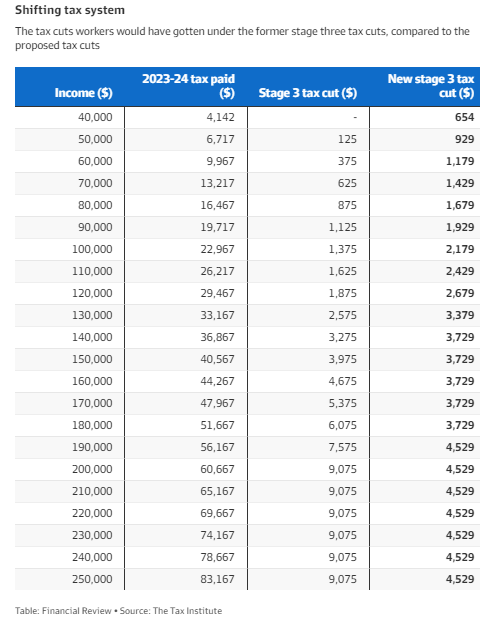
Initially, Australians earning less than $45,000 were set to miss out on the stage-three tax cuts scheduled for July. However, the proposed revisions aim to extend benefits to this group, ensuring that all Australians earning less than $150,000 will receive a tax cut. According to modeling by Assoc Prof Ben Phillips at the Australian National University, individuals earning between $50,000 and $130,000 will experience the most substantial benefits.
The key modifications include reinstating the 37% tax bracket, which was slated for removal, lowering the bottom tax bracket to 16%, and reducing the threshold for the top tax rate to $190,000. These changes, if approved, will alter the distribution of benefits, with middle-income households expected to be the primary beneficiaries, according to ANU modeling.
The proposed adjustments align with Prime Minister Anthony Albanese's focus on supporting low- and middle-income Australians facing the rising cost of living. However, the Coalition has accused Albanese of breaking an election promise not to alter the legislation for stage-three tax cuts.
The Tax Institute's analysis of the proposed changes reveals that high-income earners will see a reduction in their expected tax cuts. Those earning $200,000 and above will now receive a tax cut of $4529 instead of the initially legislated $9075. Conversely, workers earning up to $150,000 will experience a more substantial tax cut, with individuals on $130,000 receiving a $804 improvement compared to the original plan.
The changes aim to create a fairer distribution of tax benefits, providing more significant relief to lower and middle-income households. However, critics argue that the alterations represent a departure from election promises and could spark a broader discussion on comprehensive tax reform in Australia.
Chris Carlin, Senior Financial Planner and Head of Education noted
"These adjustments have the potential to introduce additional avenues for tax management, leading to substantial tax savings, especially for individuals who are self-employed or possess a discretionary trust. It is crucial to note that this analysis is contingent on the assumption that the proposed amendments pass through parliament in their current form, a scenario we view as somewhat unrealistic.”
The full details of the proposed changes are expected to be approved by caucus, but the Coalition remains skeptical, emphasizing the need for genuine tax reform rather than what they perceive as mere "fiddling."
The debate surrounding these revisions has ignited discussions about the overall tax mix in Australia, with experts like Mark Molesworth, tax partner at BDO, calling for a more profound conversation on tax reform. Australia's heavy reliance on income tax, particularly personal income tax, is a point of concern for some experts, and they hope the current changes will lead to more comprehensive discussions.
In conclusion, the proposed adjustments to the stage-three tax cuts aim to address income disparities and the cost of living pressures faced by Australians. While providing relief to low- and middle-income households, the changes have sparked political debates over broken promises and the need for more extensive tax reform in the country. The full impact of these proposed revisions remains to be seen as they make their way through the parliamentary process.
.png)
Despite significant volatility in bond yields and equities over the past quarter, major markets ultimately finished flat. This persistent tension between resilient economic activity and rising discount rates underscores the complex environment facing diversified multi-asset portfolios.
.png)
Australia's card surcharge rules have changed and the ATO will stop accepting credit card payments from December 2026. Learn how the reforms may affect consumers, small businesses and cash flow management.

Thinking of helping your children enter the property market? Learn the pros and cons of gifts, family loans and guarantor arrangements while protecting your own retirement and financial security.
Stay in the know with the latest updates, insights, and exclusive content delivered straight to your inbox.
